what were the contributions to the revoloutionary war maraquis de lafayette
 Visitors to Mountain Vernon might be surprised to run into the key to the Bastille, the notorious French prison, on display in the central hall. In 1790, Gilbert du Motier—ameliorate known as the Marquis de Lafayette—sent the key to George Washington on behalf of the people of France. To understand why Lafayette did this, it is necessary to understand the special human relationship that developed between Washington and Lafayette during the American Revolution.
The bond betwixt the two men grew so potent that they were more similar a begetter and son, rather than a commanding general and his top-ranking officer. For Lafayette, there was no better person to receive the symbol of the finish of ancient tyranny than the human who fought then bravely to establish the United states of america.
At first glance, Lafayette might seem an unlikely supporter of George Washington. Born in 1757, he came from one of France'due south oldest families. His ancestors served in the Crusades and alongside Joan of Arc. When Gilbert was 2, his father died fighting in the Seven Years' State of war. Upon the decease of his female parent when he was eleven, Lafayette inherited one of his nation'due south largest fortunes. V years afterward he married Adrienne de Noialles, a woman from an even more renowned family. But Lafayette was never impressed with status or riches, longing instead for war machine glory. He won a captain's commission in the French army and was appointed to the Black Musketeers in 1773.
However, in 1775 Lafayette's life took an unexpected turn. Like many noblemen, he lost his commission when the authorities reduced military spending. Chosen to the city of Metz for militia duty, he attended a dinner with the Duke of Gloucester, the younger brother of British King George III. The Duke complained about the American colonists who had risen up against British dominion. He mocked their revolutionary beliefs in the equality of mankind and the right of the people to rule themselves. The Knuckles farther explained how the colonists had organized the Continental Army nether the leadership of General George Washington. Lafayette would ever remember this dinner as the turning bespeak of his life. "My heart was enlisted," he afterward confessed in his memoirs, "and I thought simply of joining my colors to those of the revolutionaries."1
Lafayette studied the ideals of the American Revolution and planned to enlist in the Continental Army. Silas Deane was a representative of the Continental Congress sent to France to recruit officers. Even though Lafayette was merely xix and had no experience in state of war, Deane offered him a committee. King Louis Xvi ordered Lafayette to remain in France, simply the defiant young nobleman ignored him and set up sail for America in early 1777. When he finally arrived in Philadelphia, Congressmen James Lovell of Massachusetts refused to receive him, saying that Americans were tired of ambitious Frenchmen seeking glory. Simply upon realizing how wealthy and well-connected Lafayette actually was, and recognizing his sincere support for the American cause, Lovell recommended Lafayette's date equally a Major-General.
Lafayette proceeded to General Washington's camp along Brandywine Creek south of Philadelphia in September 1777. Here the Continental Army was fighting to halt General William Howe's advance toward the capital. Washington was immediately taken with Lafayette, especially when the Marquis explained, "I am here to learn, not to teach."2 Washington ordered Lafayette to bring together Full general John Sullivan's forces who were in a desperate fight on the army's right. The redcoats outflanked Washington and were trying to environment him. When Sullivan finally retreated, Lafayette reluctantly went with him, realizing only later that he had been shot in the leg. Washington sent his own surgeon to care for him, and when Lafayette was taken to the hospital the Full general told the doctors to, "Treat him as if he were my son."3
Afterward Lafayette recovered, he became a valued member of Washington'due south close-knit military family. Lafayette in plow came to admire Washington's leadership more than each twenty-four hours, particularly during the winter at Valley Forge. Lafayette was overjoyed when news of the French brotherhood arrived in early 1778.
In June 1778, following the Battle of Monmouth Courthouse, Lafayette returned to France hoping to win more than support for the United States. But while he was feted as a hero, he was not placed at the head of the French ground forces. Count Rochambeau was chosen instead. Past the summer of 1781, Lafayette was back in the U.s.a.. Washington sent him to Virginia to terminate British raids along the James River. When Cornwallis' forces arrived in Virginia, Lafayette harassed the British full general until Washington and Rochambeau could lay siege to him at Yorktown. In Oct 1781, there was no prouder soldier at Cornwallis' surrender than Lafayette.
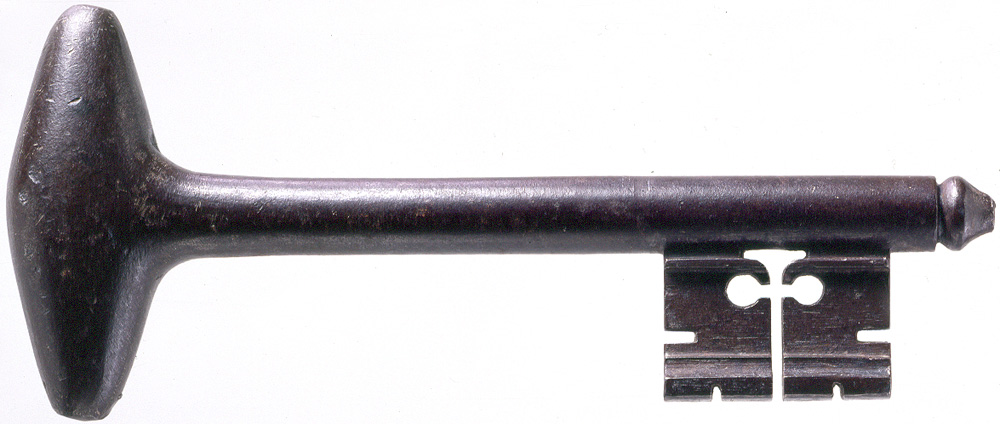
Lafayette again returned to France every bit a national hero. 3 years subsequently a tour of the Usa he visited Washington at Mount Vernon. Lafayette remembered, "Our coming together was very tender and our satisfaction was mutual."4 He discussed his many concerns about the American nation. Like Washington, he favored the cosmos of a strong central authorities. But unlike Washington he recommended an firsthand end to slavery. Back in France, Lafayette helped launch the French Revolution in 1789. He served in the National Assembly and drafted the Announcement of the Rights of Human being. He proudly sent the key to the Bastille to Washington, who was serving as the President of the United States.
Lafayette fled from France when the revolution turned violent. He was imprisoned at Olmütz by the Austrians who considered him a dangerous radical. Lafayette's fortune was confiscated past the French government and many of his relatives died past the guillotine. He was finally set gratuitous and settled at La Grange, an estate near Paris nicknamed the Mount Vernon of France.
One of Lafayette's greatest joys in his later on years came in 1824 when he made a triumphant tour of the United States. At Mount Vernon he went lonely to visit the grave of George Washington, returning to his carriage with tears in his eyes. Lafayette remained a defender of democratic ideals until his decease in 1834.
Mary Stockwell, Ph.D.
Notes:
one. Quoted in James R. Gaines, Liberty and Glory: Washington, Lafayette, and Their Revolutions (New York: W. W. Norton & Company, 2007), 37.
2. Ibid., lxx.
3. Quoted in Marc Leepson, Lafayette: Lessons in Leadership from the Idealist General (New York: Palgrave Macmillan, 2011), 37.
iv. Quoted in Gaines, 198.
Bibliography:
Gaines, James R. Liberty and Glory: Washington, Lafayette, and Their Revolutions. New York: W. W. Norton & Visitor, 2007.
Leepson, Marc. Lafayette: Lessons in Leadership from the Idealist General. New York: Palgrave Macmillan, 2011.
Marquis de Lafayette. Memoirs of General Lafayette: With an account of his visit to America, and of his reception by the people of the The states; from his inflow, August 15th, to the commemoration at Yorktown, Oct 19th, 1824. Boston: E. One thousand. Business firm, 1824.
Unger, Harlow Giles. Lafayette. Hoboken: John Wiley & Sons, Inc, 2002.
Source: https://www.mountvernon.org/library/digitalhistory/digital-encyclopedia/article/marquis-de-lafayette/
0 Response to "what were the contributions to the revoloutionary war maraquis de lafayette"
Post a Comment